Showing posts with label economy. Show all posts

Friday, December 30, 2011

You Say You Want A Resolution . . .

Hi, boys and girls! It's that time of year again, the time when every adult (And many of you kiddies) make promises to yourself that you rarely keep. Most people resolve to lose weight, exercise more, eat healthier, better their relationships, and all that good stuff. Kids resolve to do better at school, listen to their parents, get a better score in their favorite video game.

I've even seen people resolve to make no resolutions. Three different comic strips this week used that old joke.

So, what will MY resolutions be for 2012? Let's see . . .

Stop weighing in daily. Why bother?

Allow myself to eat some feast meals without feeling guilty.

Ditto eating from mouth hunger (emotional eating) in times of stress. NOT doing so only adds more stress, which eventually leads to a binge.

Watch more videos and read more books.

NOT buy any weight-loss related videos or books. I *will* allow myself the pleasure of purchasing Dr. McDougall's new book when it's finally released this year - The Starch Solution.

Here's the first chapter for those who care.

The only other books I'll allow myself to buy (as opposed to get from the library) are the few cozy mystery series I'm working on and the rest of the Dresden Files books. I still have 3 to go to be caught up. 


And that's all I'm saying for now. 2011 has been a very crazy, messed-up year, and although I HOPE 2012 will be better, I'm not too optimistic. Fat-phobia is worse than ever, not just in my own life (doctor, extended family, strangers on the street) but in the world in general. The economy still sucks. My son, who graduated with an engineering Master's degree 2 1/2 years ago, still can't get hired to even pick up dog poop and still has about $30k in student loads to pay off, so every spare penny we have goes towards helping him out. And those spare pennies are getting harder to find as prices go up in every facet of life, from a bag of beans to rent on the apartment, while income decreases as companies cut back and tax and insurance rates rise. Everyone and every thing is getting older and in need of repair or replacment, from hormones to car radiators. Winter is coming here and snow won't be far behind. Spring is a long way away. I'm just glad we got the aunt into a nursing home (and her house sold) so she won't be left alone when the roads are closed and nobody can get to her house an hour away to cook, clean, and care for her and her shovel her sidewalks and that long driveway.

Okay, so one good thing to look forward to.

Thursday, June 30, 2011

To Florida, and Back Again

I'm getting there! This is the total "miles walked" (15 minutes cardio = 1 mile) since early 2010. It's the distance between our apartment in NJ and the apartment we had in Kissimme, Florida, the place we're yearning to go back to.

When we moved there in 1999, when my husband was forced into early retirement before the age of 50 because the army base he worked in since high school was closed thanks to the BRAC committee, we moved to Kissimmee to be near my parents. My son and I loved it there, but my husband, not so much. For him it was more the shock between a government clerk job from 27 years versus the "real world" of employment and not the geographical area. After a few months he insisted we come back to urban NJ, and he insisted we move back to the same city, same neighborhood so our son can be with his old friends again. At 12 years now, this is the longest we stayed in any place since we married 33 years ago.

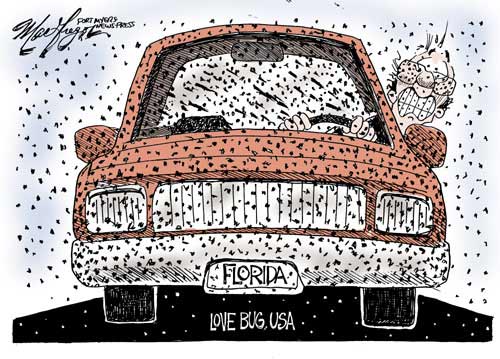
But we both want to go back to Florida. He was ready t move back on 9/11, and said at the time that if he knew it was going to happen he would have stayed down in Florida, crappy job, love bugs and all.

We spent months surrounded by armed National Guardsmen at our city's borders because of our proximity to Manhattan. Each day now when he leaves for work we never know if he'll make it there and home safe because of the subway bombing plots.

Unemployment is highest in this part of the country than anywhere else, even for those with advanced degrees like my husband and my son, or those with decades of experience in the engineering fields like my brother.

What's keeping us here, when we know we could all easily get jobs in Disney   if we moved back to Florida? The elderly aunt. She's failing since her concussion in May, but still feisty enough that we know that even though she's now 93 she could very well live to 100 or more. Since we're the only relatives that will put up with her, we're stuck here until she goes.

And as soon as she does, and as soon as her estate is settled (my husband is executor and we're willed her run down house that has to be fixed up to be good enough to sell), we're out of here and back to the Land of the Mouse, maybe even back to the same apartment complex.


Until then, I have to be content with all my Disney movie soundtrack cd's and videos, photos taken those 10 months we lived there, and this mileage ticker showing me how I could have walked down there, one step at at time.

Saturday, November 22, 2008

It's A Problem We're Having, Too

We have an elderly relative who needs assisted living but can't enter until her house is sold, and with what appears to be more houses for sale than not in her town, it looks like that's never going to happen.

http://www.nytimes.com/2008/11/22/us/22home.html?_r=1&partner=EXCITE&ei=5043
November 22, 2008

Housing Crisis Snares Elderly Who Can’t Sell

The housing crisis has kept thousands of older Americans who need support and care from moving into retirement communities or assisted-living centers, effectively stranding them in their own homes.

Without selling their houses or condominiums, many cannot buy into retirement homes that require a payment of $100,000 to $500,000 just to move in. So they are scratching themselves off waiting lists, canceling plans with packing services and staying put, in houses that fit well 30 years ago, but over the years have become lonely, too large or too treacherous to navigate.

“It is part of the hidden problem of the recession,” said Larry Minnix, president of the American Association of Homes and Services for the Aging. “Every neighborhood, every family’s got them.”

Facilities that have watched their waiting lists wither and their occupancy rates fall in the last year are now scrambling to bring people through their doors. Some assisted-living centers have called in real estate agents to teach prospective residents about online advertising and how to clean and preen their homes for showings. Others have set up programs with banks to provide bridge loans to homeowners, or are discounting apartments and offering low-interest loans.

The Cedar Community, which provides a range of housing for the elderly in West Bend, Wis., has seen independent-living occupancy rates drop by 4 percent this year. There were so many people waiting for their homes to sell that the facility decided, in some cases, to let new residents pay month-to-month until they could unload their houses and use the proceeds on the facility’s entry deposit.

“We’ve never done that before,” said Tracey MacGregor, a spokeswoman at Cedar Community.

But for people like Ruth Scher, 85, selling their home is a critical first step before moving on, or moving anywhere. Ms. Scher put her two-bedroom condominium in Delray Beach, Fla., on the market last year, but no one has made an offer.

In the 34 years since she moved to South Florida, Ms. Scher’s husband has died, the siblings who moved south from New York to join her have died, and her friends have moved away. She is recovering from a fall that broke her clavicle and suffers from arthritis in one shoulder, and she says it is time to move back.

“It’s lonesome,” Ms. Scher said. “So many other people have passed away or moved away. It’s very lonely. The children would love me to come up and I would love to, but I just can’t sell.”

Ms. Scher hoped to move to a retirement community in Cornwall, N.Y., where she has friends. But in the year her home sat on the market, she could not even find a broker willing to sell the property, she said. She finally de-listed her condominium.

“They tell you, ‘We’re sorry, we can’t get any people to come and look,’ ” Ms. Scher said. “If I can’t sell here, I can’t go nowhere.”

There is no way to say how many older Americans are in similar straits, as no statistics track how many of America’s 4.27 million unsold homes are owned by people 65 or older. But industry groups and administrators at retirement homes call the problem a growing one, which worsened as the financial crisis spread from real estate to lending markets. It has been felt worst in regions hit hardest by the housing bust.

“It remains to be seen whether we have a short-term stress, or whether we’re facing a crisis,” said Mr. Minnix, of the Association of Homes and Services for the Aging. “We’re into brand new territory here. It is deeper and potentially broader.”

Across the country, occupancy rates for independent and assisted-living facilities have fallen slightly in the last year, by about 2 percent through the middle of 2008, according to the National Investment Center for the Seniors Housing and Care Industry.

But the problem is playing out acutely in hard-hit areas like Florida, where the vacancy rate at some facilities is up 20 percent to 30 percent over last year, said Paul Williams, director of government relations for the Assisted Living Federation of America. At Luther Manor, a retiree community in Milwaukee, the number of residents moving into independent living has dropped 20 percent this year. In southern Ohio, 65 percent of the people who visited the Bristol Village retirement community this year said they could not buy a unit because their homes were still hanging around their necks.

For these businesses, each occupied room generates thousands of dollars each year. Retirement condos charge monthly fees ranging from a few hundred dollars to $5,000, while the average price for private-pay care in assisted living is $3,013 per month, or $36,156 per year, according to a MetLife study.

At the Crosby Commons assisted-living center in Shelton, Conn., where waiting lists that once ran two years or more have shrunk to six months, some residents who moved before selling their homes are spending through their savings as they wait, said Lois Poultney, the center’s director. One resident had to move from Crosby’s free-market homes to its subsidized rent-controlled apartments, Ms. Poultney said.

“I’m hearing it over and over again: ‘Mom needs to sell her house before she can afford to move in,’ ” she said.

There are signs some families and retirees are turning to adult day care services as a stopgap. Providers say their business has spiked as people look for an alternative to continuing care or home aides to provide food, companionship and therapeutic services. But Mr. Williams of the Assisted Living Federation said that people who need more day-to-day care, those who have trouble getting up stairs or who need someone to check on them, were taking a risk by staying at home.

“When they’re coming in at 85, they’re coming in very frail and needing services,” he said. “They can’t wait this out. They need the care when they need the care. That’s the scary part. You have people putting it off when they need care right now.”

For Katherine Styberg, 84, that moment of realization came when she slipped on a patch of ice in February and fractured a vertebra. She has to use a cane when she walks now, and she says she has been thinking about how she lives alone, and if she fell in her two-bedroom condominium in Milwaukee, no one could catch her or help her up.

The real estate broker calls Ms. Styberg a day before bringing potential buyers to see her apartment, and a few have come to look around, but no one has made an offer yet.

As parents linger in their homes, they say their children start to worry. Some adult children are even facing financial hardships if they cannot sell their parents’ homes.

In April, Ruth Swessel, 84, of Milwaukee, had a stroke that aggravated the effects of her aging, leaving her unable to follow “Meet the Press” or read the political magazines she once loved. Her daughter, Laura Westling, had to put her into skilled care, and the family began the process of selling Ms. Swessel’s house to pay for the facility’s $60,000 annual cost.

The house has been sitting on the market since the summer, and Ms. Swessel’s family has lowered the price twice, to $174,500 from $189,900, but they have not been able to close a deal. Her children are spending her investments to pay for her care, but Ms. Westling said they did not know what they would do once that money ran out.

“It’s not easy,” she said.

As stock markets have slid in the last year, homes have become a more critical source of wealth for retirees who have watched their mutual funds and 401(k) accounts hollow out. Next to accrued Social Security benefits, housing is the single greatest asset for people 60 to 70 years old, making up 22 percent of their total wealth and outweighing investments and pensions, according to the Center for Retirement Research. For retirees like Herman McHan, who watched the value of his mutual funds fall to $35,000, from $70,000, or Sylvia Merlin, whose portfolio has lost nearly $200,000 of value, owning an interminably on-the-market home compounds the worries of their dwindling investments.

For Ms. Merlin, it is a disconcerting place to be at age 93. She said she and her late husband, Al, had lived modestly to raise their four children, taking one vacation a year, to the Jersey Shore. She is on oxygen now, and finds it harder to get around her fifth-floor apartment outside of Philadelphia. The doorman’s wife takes her to the hairdresser on Fridays, but Ms. Merlin said she wanted more consistent care.

“I’m going to be 94, and I need help,” she said. “Making the bed is difficult. I need a little help taking a shower. Those things are difficult. I was a great cook, but I really don’t cook anymore. I bought the TV dinners, and they’re pretty lousy.”

No one has made an offer on her condominium, and Ms. Merlin said the retirement home had refunded the $1,000 deposit on the $130,000 unit she hoped to buy. Now, instead of moving, she said she had decided to stay.

“I just couldn’t go anywhere until I sold my apartment,” she said. “I and a lot of other oldsters are stuck.”


Thursday, November 20, 2008

People On-Line Thought I Was Exaggerating

People down South and from the mid-West really have no concept of how bad this economical situation is where I live. They think I live in a mansion because we pay over $1100 a month rent because they have an entire house with an acre of land, 4 bedrooms and two full baths rented for half that amount. When I say I pay over $2 for a stinking head of lettuce they accuse me of buying organic from, well, who knows where.When I mentioned a few years ago that our local hospital was laying off nurses I was told I must be making that up or mis-read something, that there's a nursing shortage. And when I mentioned that local hospitals have not only been closing specialty units (We lost maternity and pediatrics, as well as psyche and almost all out-patient services, like physio-therapy and well-child clinics) but actually going bankrupt, I was laughed it. It's not until I send them articles like these that they believed me.
Economy is sickening U.S. hospitals
Data shows decline in admissions and increase in patients who can’t pay
The Associated Press
updated 5:14 p.m. ET, Wed., Nov. 19, 2008

TRENTON, N.J. - The dismal economy has American hospitals ailing, with new data showing declines in overall admissions and elective procedures, plus a significant jump in patients who can't pay for care, the American Hospital Association said Wednesday.

Hospitals also have been hurt by losses on their investments due to the turmoil on Wall Street, and many are finding it more expensive to borrow money — if they can at all, according to a report from the association, which represents about 5,000 U.S. hospitals.

"The worst part is the combination of all of the above," said Rich Umbdenstock, the association's president and chief executive.

Some of the hardest-hit hospitals began reducing staffing and services as early as last spring and more will follow, although hospitals are trying to limit the impact on patients, said Umbdenstock. He said hospitals are more likely to eliminate entire services — money-losers or ones with high operating costs — than to make across-the-board cuts that weaken all services.

"There have been hospital closures (this year), particularly in some of the more heavily impacted areas," such as New Jersey, where hospitals are providing more and more unreimbursed care, he said.

The downturn is hitting hospitals worse than other industries, he said, and many already were struggling due to pressures including government programs such as Medicare and Medicaid not paying the full cost of treatment. Hospitals are worried the Obama administration's health care reforms will affect reimbursement rates for those two huge programs, which cover 55 percent of all hospital patients.

A hospital association survey about conditions over the past three months drew responses from 736 hospitals, and the association report also uses figures from the July-September period collected from 557 hospitals that send quarterly reports to a central system run by the Colorado Hospital Association.

The Databank hospitals' investment results amounted to a combined loss of $832 million, compared with a $396 million gain a year earlier — a big problem because normally investment gains help make up for some of the costs not covered by patients and insurers.

Meanwhile, the interest those hospitals paid on borrowed funds jumped by 15 percent in the third quarter, compared to 2007's third quarter, another difficult squeeze because hospitals generally borrow money for expansions and upgrades, multimillion-dollar technology and even sometimes to cover payroll and pay regular vendors.

Other key findings:

* 67 percent of hospitals saw some drop in elective procedures; 6 percent saw a significant drop.
* 63 percent saw some decline in overall admissions; 9 percent saw a bigger drop.
* Inpatient and outpatient surgeries and emergency department visits were all down roughly 1 percent in the third quarter.
* Half of hospitals have seen a moderate or significant jump in uncompensated care, with a jump averaging 8 percent. The association cites unemployed people losing their health insurance.
* Total profit margin at the Database hospitals dropped from an average 6.1 percent in 2007's third quarter to an average loss of 1.6 percent in 2008's third quarter.
* 56 percent of hospitals are reconsidering or postponing renovations or expansions, and about 40 percent are delaying improvements to information technology or other equipment.

Copyright 2008 The Associated Press. All rights reserved. This material may not be published, broadcast, rewritten or redistributed.
URL: http://www.msnbc.msn.com/id/27809791/

MSN Privacy . Legal
© 2008 MSNBC.com
~ ~ ~ ~ ~ ~ ~ ~ ~ ~
And this one:

Price dropoff misses N.Y.C.
BY WILLIAM SHERMAN
DAILY NEWS STAFF WRITER
Thursday, November 20th 2008, 1:20 AM
Plummeting energy costs triggered a big drop in consumer prices in the New York area last month - the biggest four-week decrease in 53 years.
The local figures - a 1% decrease for all items in the Consumer Price Index - are roughly in line with the statistics for the nation, according to Department of Labor statistics released Wednesday.
But the October fall is no reason for New Yorkers to celebrate. We're paying more for just about everything including clothing, food and rent, than we were a year ago.
Overall, the metro area CPI is up 4.3% for the year in categories that include a 6.7% spike in food and beverage costs, while apparel is up 4.5%, and rent has grown 5.5%, according to the New York Office of the Bureau of Labor Statistics.
And one item, the increase in food prices here, including a 0.5% pop up last month, is a mystery to government economists.
"There's really no explanation for rising food prices," said Michael Dolfman, Regional Commissioner for the Bureau.
"When fuel prices go up, you expect merchants to pass those increases on to consumers and fuel is a big component of food costs because food has to be delivered," he added, "but now we have a drastic reduction in fuel costs and we haven't seen reductions in food and commodity costs."
An answer to the mystery was suggested by several retail merchants interviewed. Once prices go up for most goods and services, it's very rare to see them go down.
"Flour is down, but my bread suppliers haven't reduced their prices," said Saul Zabar, owner of Zabar's, the specialty food emporium on Manhattan's West Side.
"I know other commodities are down, eggs and milk but it's the same there. We have to go after the wholesalers and get them to pull their prices down," he said.
Still, there are bright notes for New York consumers that showed inflation is in check, according to the October statistics.
Energy costs fell 9.2% for the month, and medical care, a category that had been rising sharply for the past five years, fell 0.4%.

Tuesday, November 04, 2008

How much does it really cost to eat a healthy diet?

Money Is Tight, and Junk Food Beckons

How much does it really cost to eat a healthy diet?

Economists, health researchers and consumers are struggling to answer that question as food prices rise and the economy slumps. The World Bank says nearly a billion people around the world live on a dollar a day, or even less; in the United States, the daily food-stamp allowance is typically just a few dollars per person, while the average American eats $7 worth of food per day.

Even middle-class people struggle to put healthful food on the table. Studies show that junk foods tend to cost less than fruits, vegetables and other healthful foods, whose prices continue to rise.

This fall a couple in Encinitas, Calif., conducted their own experiment to find out what it was like to live for a month on just a dollar a day for food. Overnight, their diets changed significantly. The budget forced them to give up many store-bought foods and dinners out. Even bread and canned refried beans were too expensive.

Instead, the couple — Christopher Greenslate, 28, and Kerri Leonard, 29, both high school social studies teachers — bought raw beans, rice, cornmeal and oatmeal in bulk, and made their own bread and tortillas. Fresh fruits and vegetables weren’t an option. Ms. Leonard’s mother was so worried about scurvy, a result of vitamin C deficiency, that they made room in their budget for Tang orange drink mix. (They don’t eat meat — not that they could have afforded it.)

Breakfast consisted of oatmeal; lunch was a peanut butter and jelly sandwich. Dinner often consisted of beans, rice and homemade tortillas. Homemade pancakes were affordable, but syrup was not; a local restaurant gave them a few free syrup packets.

One of the biggest changes was the time they had to spend in meal preparation.

“If you’re buying raw materials, you’re spending more time preparing things,” Mr. Greenslate said. “We’d come home after working 10 to 11 hours and have to roll out tortillas. If you’re already really hungry at that point, it’s tough.”

While he lost weight on the budget diet, Mr. Greenslate said, the larger issue was his lack of energy. During the experiment he was no longer able to work out at the gym.

A few times they found a bag of carrots or lettuce that was within their budget, but produce was usually too expensive. They foraged for lemons on the trees in their neighborhood to squeeze juice into their water.

Ms. Leonard said that after the 30-day experiment, one of the first foods she ate was a strawberry. “I almost cried,” she said.

The couple acknowledged that the experiment was something of a luxury, given that many people have no choice about how much to spend on food.

“People in our situation have the leisure to be concerned about issues like this,” Ms. Leonard said. “If we were actually living in this situation, I would not be taking the time to be concerned about what I could and could not have; I’d be worried about survival.”

Researchers say the experiment reflects many of the challenges that poor people actually face. When food stamps and income checks run low toward the end of the month, they often do scrape by on a dollar a day or less. But many people don’t know how to prepare foods from scratch, or lack the time.

“You have to know how to cook beans and rice, how to make tortillas, how to soak lentils,” said Adam Drewnowski, director of the Center for Public Health Nutrition at the University of Washington. “Many people don’t have the knowledge or the time if they’re working two jobs.”

Last year, Dr. Drewnowski led a study, published in The Journal of the American Dietetic Association, comparing the prices of 370 foods sold at supermarkets in the Seattle area. The study showed that “energy dense” junk foods, which pack the most calories and fewest nutrients per gram, were far less expensive than nutrient-rich, lower-calorie foods like fruits and vegetables. The prices of the most healthful foods surged 19.5 percent over the two-year study period, while the junk food prices dropped 1.8 percent.

Obesity researchers worry that these trends will push consumers toward less healthful foods. “The message for this year and next year is going to be affordable nutrition,” Dr. Drewnowski said. “It’s not the food pyramid, it’s the budget pyramid.”

The experiment in California was hardly the first of its kind, though the teachers’ budget was tighter than most. Last month Gov. Jennifer M. Granholm of Michigan and her family took a weeklong “food stamp challenge,” spending only $5.87 per day per person on food — the Michigan food stamp allotment. She told reporters that she ended up buying a lot of macaroni and cheese. Last year Gov. Theodore R. Kulongoski of Oregon lived for a week on his state’s $3-a-day food stamp allocation.

Ms. Leonard and Mr. Greenslate, who chronicled their dollar-a-day experience on their blog, onedollardietproject.wordpress.com, say they are looking at other ways to explore how difficult it is for people with limited income to eat a healthful diet.

“I challenge anyone to try to live on a dollar a day and eat fresh food in this country,” Mr. Greenslate said. “I would love to be proven wrong.”

I Miss Richard Simmons

 The voice, the hair, the outfits, that laugh - I miss every single thing about that glitzy, ditsy, outrageous person. Oh, yes, his workouts...